For people who experience foot drag or have difficulty walking without tripping, the right footwear can make a world of difference in their safety, confidence and independence. This is of particular concern for older adults: Falls are the leading cause of injury and even death among older adults, and about one in three adults aged 65 and older experience at least one fall annually. Cadense, an AgeTech Collaborative™ startup participant, is developing adaptive shoes that combine patented Glide & Grip technology with everyday style, helping wearers navigate common obstacles more smoothly while maintaining the traction they need for grip and stability.
We spoke with Johannes Sauer, CEO and Co-Founder, and Dr. Nathan Estrada, VP Clinical, to discuss the technology behind the shoes, the research into their potential to reduce falls and why designing for what people want is just as important as addressing what they need.
This interview has been edited for clarity and length.
Falls represent a serious concern for many older adults, especially those who have mobility challenges. How is Cadense working to address this problem?
Johannes: Cadence makes adaptive footwear for people who worry about tripping and falling, allowing them to walk more safely, comfortably and confidently. We offer a whole range of footwear, from nice-looking sneakers to dress shoes and sandal-slippers, each with our patented Glide & Grip technology built in.
What is your Glide & Grip technology, and how does it work?
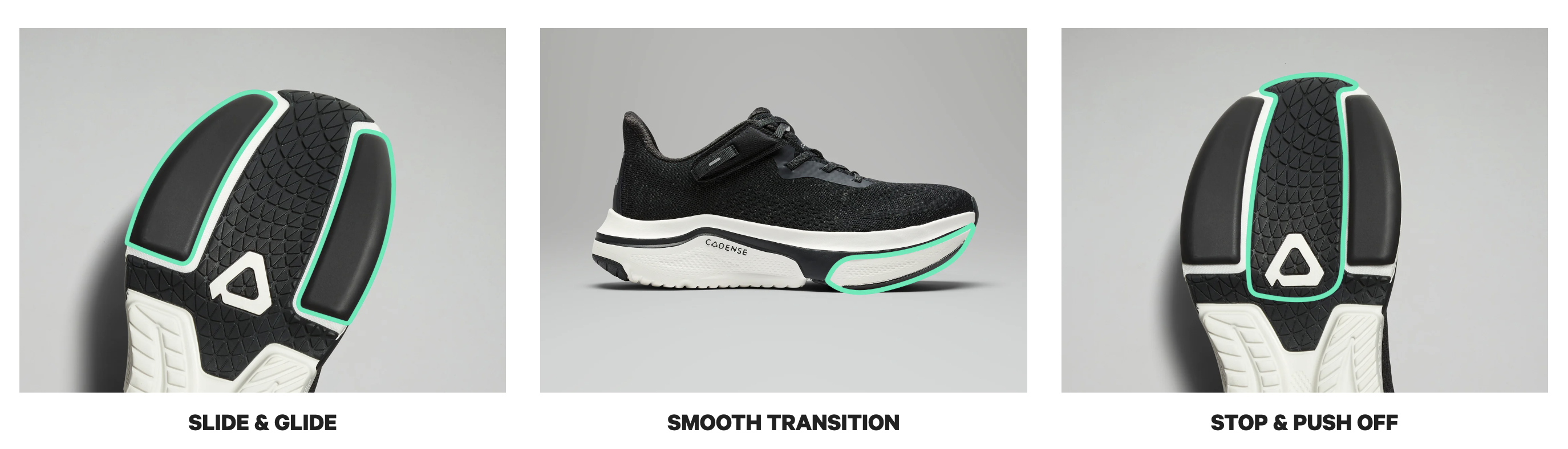
Johannes: If you look at the shoe from the front, it looks like a catamaran: Each shoe has two “glide zones” on the outside edges of the bottom of the shoe. When there is no weight on the shoe, the grippy rubber section in the middle sits recessed about three or four millimeters compared to the nylon “blades” on the outside. So when you lift your foot and take a step, the blades contact the ground first and allow you to glide over obstacles. But when you put your weight on the front of the shoe, soft foam beneath the nylon sections compresses, and the grippy rubber section contacts the ground. So you can glide during the first part of your step, but as soon as you put your weight on the sneaker, you get safe traction to take your next step. The shoe transitions with the application of your body weight.
Nathan: The shoes also have a ski slop on the front and a rocker bottom that help you progress from heel to toe. If you wear a normal shoe and you hit a curb, your foot is arrested and immediately you stumble. People without mobility challenges might have the skills to recover from that and regain their balance, but if you have vulnerabilities when it comes to walking, that stumble becomes a fall.
It seems like an ingenious and deceptively simple solution. What was the development process like?
Johannes: Well, it only took us 12 years to get here! It started with a research project that my co-founder, Dr. Tyler Susko, did at MIT. It was called the MIT-Skywalker, and it was designed to conduct post-stroke rehab. It was a treadmill system with a camera that would remove the treadmill beneath your feet, effectively removing the “ground” beneath you as you move your legs. One participant in the study said, “It would be awesome if we could replicate this outside of the laboratory and it didn’t cost a million dollars.”
In the real world, you can’t alter the ground people walk on — but you can modify their footwear. My co-founder went through the process of transforming the robotic MIT-Skywalker into a robotic shoe, but those were heavy and costly. We then went to sneakers that incorporated different things into the bottom of the shoe to validate that the glide technology could actually work. Then we went into the design phase where we had to figure out how to scale it and make sure it is affordable. So we went from high-tech to low-tech while embedding the philosophy of the MIT-Skywalker into our shoes. But we had to go through that multi-step process, because there are no shortcuts to success in that regard.
What makes footwear such a promising way to address fall risk and help people stay active and independent versus, say, physical rehab?
Nathan: When you look at why the shoe can be so impactful, it’s because shoes are universal. Whether you have Parkinson’s, or MS, or age-related changes, we’re all putting on shoes. It’s a behavior that gives us this great opportunity to have a broad impact.
Fall risk is a universal and continuous factor everywhere we go. Often we focus on intermittent interventions, such as physical therapy, or making grandma’s shower safer. But what about the rest of the world that people have to live in? By making the shoe itself the solution, we can move with the person throughout the world they want to engage in. We no longer have to focus only on making grandma’s house safe; instead, we can make the world safer for grandma so she can participate more fully in the world in the way that she wants to.
When designing a shoe that helps prevent falls, what do you have to think about differently from a conventional shoe?
Nathan: When we think about safety, we automatically think that we need a super grippy shoe because we don’t want to slip. But slips account for only 8% of falls. Meanwhile, trips account for 40% of falls, but we tend to blame trips on the environment, not our shoes: “I tripped over the sidewalk,” we say. But the more grippy you make the shoe, the easier it is to trip. For older adults and others with walking challenges, a high-grip shoe is a tripping magnet.
Our Glide & Grip shoes take advantage of the fact that your walking pattern naturally changes where your weight falls. They act like a normal, grippy shoe anytime there’s body weight on it, so we solve for the slipping. Then, when the person steps and takes the weight off the shoe, we solve for the much bigger problem of tripping.
There are other factors you have to consider to make a safe, well-balanced shoe. They need to have great lateral stability; they need a wider toe box for people with foot dysfunction. If you make it too soft, you’re decreasing a person’s balance. You can’t just put an innovative sole on a shoe and say, “I’m done.” There are a lot of factors that go into making it right.
A recent study examined the impact of Cadense footwear on falls and fall-related medical care. What did the researchers find?
Nathan: The study was conducted by the Shirley Ryan AbilityLab, the number one research institution for rehabilitation scientists in the country. The primary findings are pretty tremendous. People using our shoes experienced an 87% reduction in reported fall frequency. What I’m even more excited about is that prior to using our shoes, only 22% of respondents were non-fallers, but after wearing Cadense shoes, 84% said they had not fallen since they started wearing our shoes. And among those people that did still fall, there was a 93% reduction in the need to seek medical care after the fall.
I think of it like this: When you stop falling, what does that do to your confidence regarding moving around in your world again? Because you don’t have a constant reminder of your disability, and you actually have a reminder of your success instead, you can start living again.
Where do you see new or ongoing opportunities for AgeTech innovation to improve how they serve older adults?
Nathan: I think one of the biggest opportunities that we have in AgeTech is dignifying and honoring aging, not stigmatizing and medicalizing it.
For example, you don’t have to advertise that someone has a problem with falling in order to solve that problem. We don’t have to make a shoe that looks like a medical device. Instead, we can actually make something that’s both delightful for someone and solves their problem. We can get so busy telling people what they should do that we forget it’s actually about what they want — and what they want is great-looking shoes. If you don’t honor the things they want, you don’t get engagement. So I think the single greatest limitation we have in AgeTech is engagement because we often start with the solution itself, instead of understanding how the people who are actually going to use the solution want the problem to be solved.
What are you most excited about in the coming months for Cadense?
Nathan: What excites me most is this incredible signal we have from this study. Now it’s time to expand that signal into prospective multicenter clinical trials and actuarial studies with health insurance companies.
One of the big problems we have in the industry is when innovators get their first positive signal and say, “We won!” But we’re absolutely not stopping here. We’re going to continue validating and demonstrating because the more value we demonstrate, the better able we’ll be to deploy the shoes to vulnerable populations. Our impact will only grow from here.
To learn more about Cadense’s adaptive footwear and Glide & Grip technology, visit the company’s website.
#StartupSpotlight