AgeTech has come a long way in recent years, with innovators developing solutions that touch nearly every part of the aging experience. Across the AgeTech Collaborative™ (ATC) ecosystem, that includes companies rethinking hearing health, helping people sleep better as they age, bringing more care and monitoring into the home, using AI to help make healthcare more responsive and human, and many other groundbreaking solutions. On the whole, older adults are quite interested in using these solutions, yet actual adoption of these technologies remains uneven. The question is: Why?
Teaming up to explore this gap between interest and adoption, the AgeTech Collaborative and AARP Research have launched the “Applied AgeTech in Real Life” series, beginning with Applied AgeTech in Real Life: Why Human-Centered Application in AgeTech Matters Now, a white paper that introduces the series’ central thesis and a framework for understanding how AgeTech interacts with the realities of aging. Three subsequent reports apply that framework to different areas of AgeTech, exploring how solutions intersect with the needs and experiences of real people — and offering practical insights to help innovators design technology with those realities in mind.
The challenge is multifaceted, but a pair of central insights emerged from the research. The first is that as AgeTech evolves, the obstacles to adoption are shifting from being about what the technology itself can do for older adults, to more about how well that tech fits — or doesn’t fit — into their everyday lives. As the white paper finds, “The next phase of AgeTech depends on applied human-centered insight, not additional technology capabilities.”
For innovators, solving that challenge means looking beyond their solution’s raw technological capabilities and understanding the on-the-ground, real-world factors that influence whether people will use, trust and adopt a particular AgeTech solution.
In turn, to truly understand those real-world factors, innovators must embrace a second crucial insight: older adults are not a single, homogeneous group. To better facilitate this understanding, the white paper lays out a framework by which older adults fall into one of three cohorts — Active, Supported or Assisted — depending on a number of factors. Because this cohort framework is such a foundational throughline across all three reports, we offer here a primer and handy reference for how each cohort is defined.
Understanding the Three Cohorts
Chronological age alone doesn't indicate what someone needs from technology. People experience aging differently, and their needs can change as their health, mobility, independence and caregiving circumstances change. Someone may move from needing little or no assistance to requiring more support over time, for example, and those transitions don't necessarily happen in a straight line. In short, the three cohorts are defined not simply by age, but by people's changing needs, priorities and levels of independence. Here’s a closer look at each one.
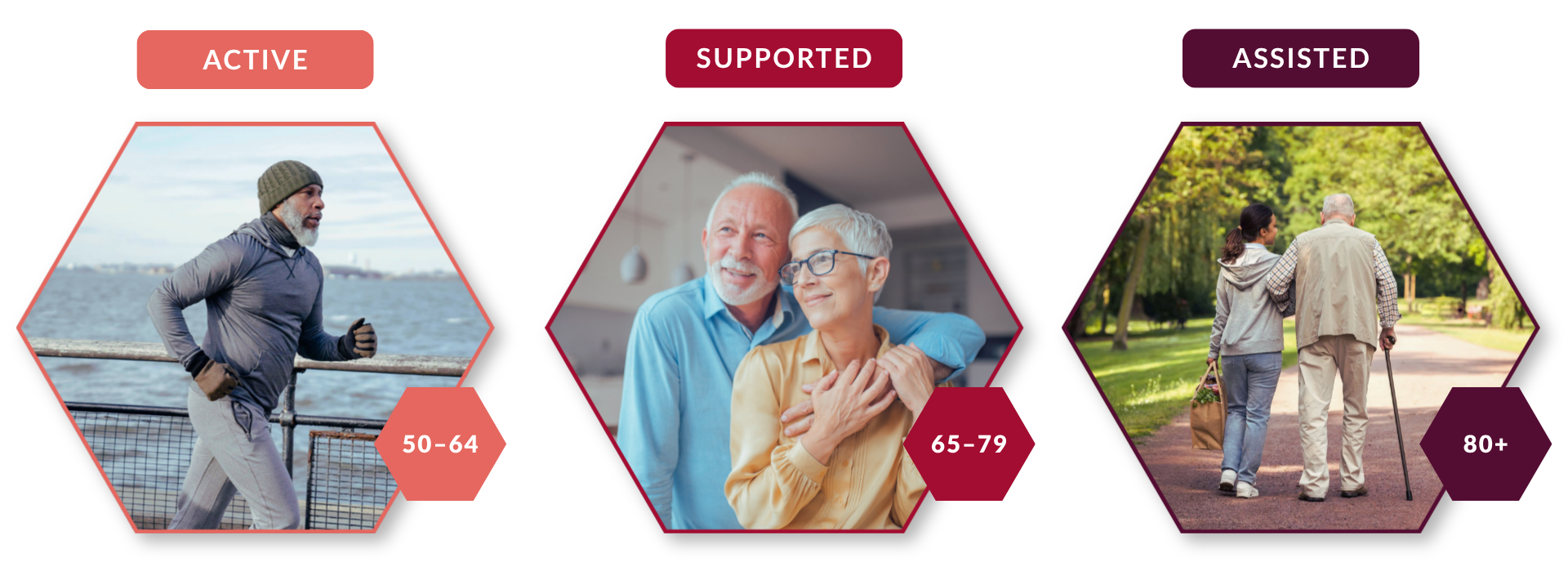
Active: Focused on prevention and maintaining independence
Generally aged 50–64, Active adults are typically looking ahead and thinking about how to maintain their health, independence and quality of life as they age. They may be highly comfortable with technology and interested in tools that help them monitor their health, build healthy habits, stay socially connected and plan for the future.
For this cohort, technology is less about addressing significant assistance needs and more about prevention, wellness and maintaining momentum.
Supported: Managing change while preserving independence
Often aged 65–79, adults in the Supported cohort may be experiencing more noticeable changes in health, mobility or daily life. They may also be managing multiple health conditions or beginning to encounter new challenges that make everyday tasks more complicated.
Nevertheless, independence remains a central priority. Technology for this cohort should help reduce friction and uncertainty while allowing people to maintain control over their lives and stay connected to their communities.
Assisted: Supporting care, dignity and continuity
Typically aged 80 and older, Assisted adults are more likely to rely on family members or paid caregivers for some aspects of daily life. Their priorities may increasingly center on aging in place, maintaining comfortable routines, preserving dignity and making caregiving easier for everyone involved.
Technology can play an important role here by supporting care coordination, monitoring, communication and continuity — while helping people remain as independent and engaged as possible.
Why the Cohorts Matter for AgeTech Innovators
The three cohorts provide a way for designers, innovators and researchers to think beyond the broad category of “people 50-plus” and consider how needs and priorities change throughout the aging journey.
The same technology, for example, may have very different value depending on where someone falls within that journey. A solution designed around prevention and wellness may be highly relevant to an Active adult but less useful to someone managing complex care. Conversely, a technology designed for people who need assistance shouldn't assume that everyone over a certain age wants or needs that level of support.
For AgeTech innovators, understanding these differences can help inform everything from product design and messaging to user research and go-to-market strategies. Most importantly, it can help ensure that technology targets genuine needs and addresses real-life barriers to adoption, rather than simply solving problems for generic “older adults” in an idealized setting.
Applying the Framework to Real Life
The series of Applied AgeTech in Real Life reports puts this framework into practice by examining three areas where technology is playing an increasingly important role in the aging experience:
-
Aging in Place: What does it take for older adults to remain safely and comfortably in their homes and communities — and where can technology help?
-
AI and Independence: How are older adults using and evaluating AI as a tool for maintaining independence, and where does today's technology fall short?
-
Caregiver Tech: How can technology help caregivers navigate the growing complexity of providing care at home, including coordination, monitoring and communication?
Together, the reports are intended to provide practical insights for the AgeTech ecosystem. As the white paper explains, the series is designed to assist designers and innovators in building for reality from the start, startups in identifying unmet needs before scaling, and media in grounding AgeTech narratives in lived experience.
Ultimately, the goal is to help move AgeTech from technological possibility to widespread adoption and meaningful, sustained use. Understanding who people are, what they need and how those needs change over time is an essential part of making that happen.
Dive Deeper Into the Research
Ready to explore the findings in more detail? Start with the full Applied AgeTech in Real Life: Why Human-Centered Application in AgeTech Matters Now white paper for a deeper look at the framework behind the series. Then, see that framework in action in the first two topical reports, exploring aging in place and AI and independence.
We’ll also be continuing the conversation here on the ATC blog, taking a closer look at each report’s key findings and exploring what they mean for AgeTech innovators in practice.
#ResearchandResources